

Sizing up might ease pressure across your forefoot, but it can also leave extra length and heel movement. The best football boots for wide feet aren’t simply the biggest size or the model with the most forgiving reputation. Fit depends on where your foot needs room and how the boot holds it in place.
If your usual size feels tight across the front, width, length, and shape all matter. A boot that looks roomy may still press in the wrong spot, and a model name alone can’t confirm a comfortable fit.
This guide explains how to assess boot shape, upper materials, sizing, and playing surface before ordering. You’ll compare options such as Nike Phantom, Adidas Copa, Puma Future, and Mizuno football boots without treating any model as a guaranteed fit for wide feet. You’ll also learn which product page details to check, how to spot excess length or heel movement, and when to consider another option. Make your decision using fit cues, not guesswork.
Key Takeaways
- Assess forefoot room, upper adaptability, and heel lockdown together when looking for the best football boots for wide feet.
- Compare manufacturer fit guidance and confirmed product details. Don’t assume that a brand or range fits every wide foot.
- Measure both feet later in the day while wearing your football socks, then check the specific model’s size chart.
- Match the outsole to your playing surface, then assess length, toe comfort, and heel hold as a complete fit.
- Before choosing, confirm current stock, available sizes, product specifications, and return terms.
Best football boots for wide feet start with fit, not a bigger size
A wide-foot fit problem often feels like pressure across the forefoot or toes, even when the boot’s length seems right. That’s different from a boot that’s simply too short. Adding length may create more room in front of the toes, but it doesn’t necessarily provide useful space across the sides of your foot.
Separate four fit factors before choosing a size: width is side-to-side room; volume is the space around your foot, including over the instep; toe shape is how the front of the boot matches your toes; and length is the distance from heel to toe. These factors interact, but one can’t reliably replace another. Boot designs and materials vary, as outlined in Football boots, so assess the exact model rather than assuming every boot from a brand fits alike.
The best football boots for wide feet depend on where your foot needs room and how the boot secures it. No brand or model guarantees comfort for every wide-foot shape. Treat product specifications and manufacturer sizing guidance as details to check, not promises of fit.
How to tell whether width is the real fit problem
Reassess the fit if the sides of your forefoot feel squeezed, your toes are compressed, or your foot bulges over the sole edge. Numbness or increasing pressure are also reasons to stop and check the fit rather than assuming the boot will become comfortable. By contrast, heel slip or extra space in front may point to excess length or poor lockdown. Pressure on top of the foot may relate to instep volume.
Check both feet. Measurements can differ, so use the larger or more demanding foot as your reference. A comfortable fit while standing should still feel secure when you move.
Why simply sizing up can create new problems
A larger size can add length without solving pressure across the forefoot. Extra room at the toe may let your foot slide inside the boot during acceleration or direction changes, reducing your sense of lockdown. It can also cause heel movement even if the front still feels tight.
Compare the size chart and fit guidance for the specific brand and model you’re considering. Don’t assume the same size or size adjustment will work across every boot. Reconsider the fit if pressure persists, your toes feel compressed, or your heel lifts when you move. Look for enough room where you need it, with a secure hold elsewhere.
How to compare football boots for wide feet: shape, upper, and closure
Use the same four checks for every pair: forefoot room, upper adaptability, lockdown, and verified size guidance. This stops a roomy-looking toe or familiar brand name from doing all the work. The best football boots for wide feet are the ones whose published details and actual fit suit your foot, not simply boots described as comfortable.
| Evidence | Shopper check | Remaining uncertainty |
|---|---|---|
| Forefoot shape and product photos | Look for clear views of the toe area and compare its outline with your foot shape. | Photos don’t confirm how the boot feels on your foot. |
| Upper material and construction | Check the product page for specific materials and construction details. | Material alone can’t establish how much room or flexibility you’ll feel. |
| Lacing and closure details | Consider whether the lacing can be adjusted comfortably across your instep. | Adjustability doesn’t prove the forefoot will fit. |
| Manufacturer size chart and fit guidance | Compare the model’s guidance with your measurements. | Guidance can’t account for every foot shape or personal preference. |
What boot shape and upper details can tell you
Read the product description for confirmed upper materials and construction, then study clear photos from multiple angles. Supple materials may feel different from more structured ones, but don’t assume an upper will stretch enough to relieve pressure. Look for manufacturer fit guidance for the exact model. If width or toe shape isn’t specified, treat it as unknown rather than guessing.
Apply the same standard across brands and models. A material label or lacing layout can help you form questions, but neither confirms a wide fit. Compare available Nike, Adidas, Puma, and Mizuno boots by their published details, and check current specifications before relying on them.
How to judge secure lockdown without forefoot squeeze
Heel hold and midfoot security are separate from pressure around the toes. Lace the boot to hold your heel and midfoot without creating uncomfortable instep pressure, then assess the forefoot separately. A snug feel doesn’t prove the size is right if your toes or the sides of your foot are squeezed.
Check the fit while standing, then move to see how the boot holds your foot. Watch for heel lift or sliding, and notice whether adjusting the laces creates pressure across the instep. No closure setup guarantees comfort. Use it to fine-tune lockdown, not to disguise a poor shape or length.
Once you know what to compare, browse the football boot selection and check each product page against your fit priorities.
Football boot models to compare when you have wide feet
Model names can help you build a shortlist, but they can’t confirm how a boot will fit your foot. Treat each listing as a set of details to verify: published upper construction, surface, available sizes, and manufacturer fit guidance. A model’s presence in a collection doesn’t make it suitable for wide feet, and details can vary between versions.
The examples below are starting points for research, not fit recommendations. The model names indicate FG versions, but check each current product page to confirm its specifications, size options, and surface guidance before ordering.
| Model to investigate | Upper details | Surface | Size and fit guidance | Wide-foot fit |
|---|---|---|---|---|
| Nike Phantom 6 Elite FG | Unconfirmed: check the current product page. | FG in model name: verify the listing. | Unconfirmed: check sizes and manufacturer guidance. | Requires individual assessment: the listing name doesn’t establish fit. |
| Adidas Predator 26 Elite Tongue FG | Unconfirmed: check the current product page. | FG in model name: verify the listing. | Unconfirmed: check sizes and manufacturer guidance. | Requires individual assessment: the listing name doesn’t establish fit. |
| Mizuno Morelia Neo IV Japan FG | Unconfirmed: check the current product page. | FG in model name: verify the listing. | Unconfirmed: check sizes and manufacturer guidance. | Requires individual assessment: the listing name doesn’t establish fit. |
Compare the Nike, Adidas, and Mizuno examples carefully
Start with the exact model and version. Check its product page for named materials, construction details, size availability, and manufacturer fit advice. Don’t infer width from brand reputation, a premium tier, or a family name. For speed-boot context, see this Nike Mercurial Superfly buying guide, but assess any specific pair using its own published details.
Match the outsole to the surface you actually play on
FG, TF, and indoor outsoles are intended for different playing surfaces. They don’t indicate boot width. Confirm surface compatibility on the current product page and choose a soleplate for your pitch or court first. Then assess fit separately: suitable traction can’t compensate for forefoot pressure, excess length, or poor heel hold.
Use the comparison to narrow your shortlist, not to predict comfort. A published detail is evidence to consider; the final fit still depends on your foot shape and how the boot feels when worn.
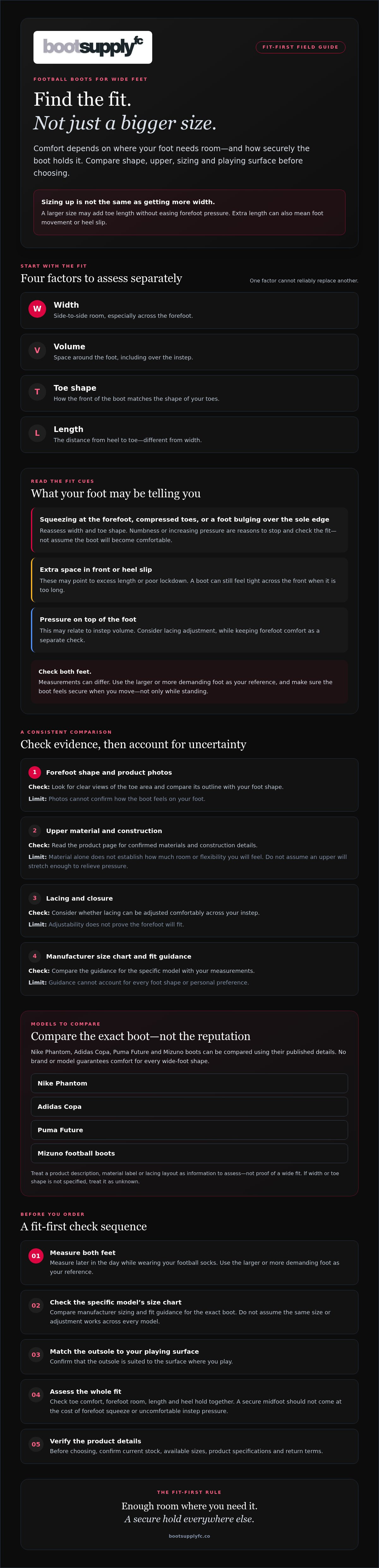
How to check football boot fit before ordering online
Online sizing takes a few checks, not a guess. Measure both feet, use the size chart for the exact model, compare published fit details, then assess the boots carefully indoors. This won’t replace trying a pair on, but it can help you catch mismatches before wearing them on a pitch.
- Step 1: Measure both feet. Do this later in the day while wearing your football socks. Stand on paper and record the distance from the back of your heel to your longest toe, then measure across the widest part of your forefoot. Use the same method for both feet and keep both measurements.
- Step 2: Consult the model’s size chart. Compare your measurements with the manufacturer’s chart for that specific boot. Don’t assume size conversions or fit are identical across brands. If the chart gives no width guidance, treat that as unknown rather than guessing.
- Step 3: Compare product details. Check the current product page for stated upper materials, construction, size options, and manufacturer fit advice. Look for details relevant to your pressure points, but don’t treat a material description as proof that the boot will suit your foot.
- Step 4: Assess the fit indoors. Check toe clearance, forefoot pressure, heel movement, and instep comfort while standing. Only try gentle football movements if the retailer’s current return terms allow it.
Measure both feet and compare the correct size chart
Measure on a firm, level floor with your weight evenly distributed. Record the heel-to-toe length and widest forefoot measurement for each foot. Use the larger measurement as a reference when checking the chart, but don’t automatically size up. The chart’s guidance and the boot’s shape still matter. If there’s no published width information, the chart alone can’t confirm how the model will accommodate your forefoot.
Use a short movement check to assess comfort
Start by standing in the boots. Your toes shouldn’t feel jammed, the forefoot shouldn’t be under persistent pressure, and the heel shouldn’t lift excessively. Check that the instep feels comfortable when the laces are adjusted. If the retailer’s terms allow it, try gentle steps, turns, and short accelerations indoors. Stop if pain, numbness, or persistent pressure appears. Don’t count on break-in to fix a poor fit.
Before ordering, read the retailer’s current exchange and return terms so you know what conditions apply to an indoor fit check. Once you’ve identified your size and fit priorities, compare football boots by model and product details.
Choose your next pair with a fit first shortlist
A focused shortlist makes it easier to compare options. Keep models that match your playing surface and measurements, then check how their published details address your fit needs. The best football boots for wide feet aren’t defined by a label alone. Look for suitable length, comfortable forefoot room, and secure heel hold in a boot made for the surface you play on.
Build a shortlist from your measurements and playing surface
First remove boots that don’t match your playing surface. Then compare the remaining product pages against your fit priorities. Give preference to listings with clear size information, confirmed construction details, and manufacturer fit guidance. If width remains uncertain, keep another option on your shortlist instead of assuming the first model will work.
- Surface: Confirm that the outsole suits where you play. FG, TF, and indoor options are intended for different surfaces.
- Length: Use your measurements and the specific model’s size chart. Don’t add length just to get more width.
- Forefoot room: Look for relevant published fit information, then check that the toe area feels comfortable without squeezing.
- Heel hold: Check that your heel stays secure without needing to overtighten the boot.
Browse available football boots and verify before checkout
BootSupply FC’s collection includes Nike, Adidas, Puma, and Mizuno football boots, with options for firm ground, turf, and indoor surfaces. Use it to compare available models after setting your fit priorities. Don’t assume boots from the same brand, or even the same model family, fit alike. Check each product’s current details individually.
Before checkout, verify current stock and available sizes, then review the product specifications and the retailer’s current return terms. If a listing doesn’t state width or leaves a key construction detail unclear, treat it as unresolved. A clear product page can help you make a better-informed choice, but it can’t guarantee how a boot will feel on your foot.
Use your shortlist to narrow the options, not force a fit. Choose a model based on its verified product details, surface compatibility, and the fit cues that matter to you.
Make your next boot choice with confidence
The best football boots for wide feet aren’t chosen by size alone. Use your measurements, the model’s published fit guidance, and a careful fit check to balance forefoot comfort with secure heel hold. Treat model names as options to investigate, not guarantees of a comfortable fit.
BootSupply FC offers football boots from Nike, Adidas, Puma, and Mizuno, with options listed for FG, TF, and indoor surfaces. Compare current product details, size options, and surface information, then check the retailer’s return terms before ordering. BootSupply FC ships worldwide, so you can explore the collection wherever you play.
Ready to build your shortlist? Browse football boots and compare available models by their verified product details, size options, and surface information.
Frequently Asked Questions
Are football boots designed specifically for wide feet?
Some manufacturers offer wide-fit options, but availability varies by brand, model, and size. Check the exact product page and manufacturer guidance for an explicit width option rather than relying on a boot’s reputation or appearance. A wide-fit label still can’t guarantee comfort for every foot shape, since width, foot volume, and toe shape differ. Assess forefoot room and heel hold together before deciding.
Should I size up in football boots if I have wide feet?
Not automatically. A larger size may add length without giving your forefoot the room it needs, leaving your toes too far from the front and allowing heel movement. Compare your foot measurements with the specific model’s size chart first. If the chart doesn’t provide width guidance, treat fit as uncertain and consider another model instead of assuming extra length will solve the squeeze.
How can I tell if football boots are too narrow?
Forefoot pressure, squeezed toes, numbness, or your foot bulging over the sole edge are signs to reassess the fit. Check where discomfort occurs: pressure on top may relate to instep volume, while heel slip or excess space at the toe can indicate a length or lockdown issue. Try the boots with your football socks and stop if pain or persistent pressure appears.
Which football boot brands are best for wide feet?
No brand is best for every wide-foot shape. Fit varies between models, so compare the exact boot’s published width or fit guidance, size chart, upper details, and available sizes. BootSupply FC carries football boots from Nike, Adidas, Puma, and Mizuno, but a brand’s presence in the collection doesn’t establish a wide fit. Choosing the best football boots for wide feet is a model-by-model decision.
Are leather football boots better for wide feet?
Not necessarily. Some leather uppers may soften or adapt with wear, but that doesn’t guarantee enough room for a wide forefoot or relief from pressure. Check the product page to confirm the upper material, and don’t rely on stretching or break-in to correct a poor fit. The boot should feel comfortable where your foot needs space while still holding your heel securely.
Can I wear FG football boots on artificial grass if I have wide feet?
Foot width doesn’t determine whether an FG outsole suits artificial grass. FG, turf, and indoor outsoles are intended for different playing surfaces, so check the manufacturer’s guidance for the exact boot and surface you play on. Don’t assume an FG model is suitable for artificial grass based on fit or availability. Choose surface compatibility first, then assess the boot’s fit separately.
How do I buy football boots for wide feet online?
Measure both feet later in the day while wearing your football socks, recording length and the widest point of your forefoot. Compare those measurements with the exact model’s size chart, then check published upper, width, and fit details. Treat missing width information as uncertain. Before ordering, review the retailer’s current return terms. On arrival, assess toe clearance, forefoot pressure, heel movement, and instep comfort indoors before wearing the boots on a pitch.